
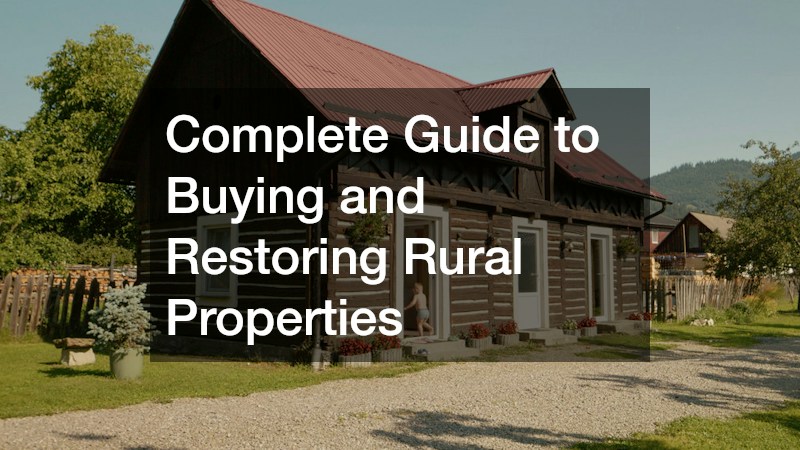
The pull toward rural living has never been stronger. Across the country, buyers are trading compact suburban subdivisions and crowded metropolitan corridors for open acreage, sweeping pastures, and historic homesteads. The promise of privacy, self-reliance, and architectural character is deeply compelling. Yet, purchasing and revitalizing a rural parcel involves an entirely different set of rules than buying a turnkey home in a planned community.
When you purchase a home within city limits, municipal utilities handle your drinking water, sewer treatment, storm run-off, and trash collection. Building codes are standardized, access roads are maintained by local public works departments, and property boundaries are clearly established by recorded plat maps. Once you cross into unincorporated country acreage, every single one of those municipal safeguards disappears. You become the owner, manager, and operator of your own miniature utility district and infrastructure network.
Restoring an older rural property requires patience, capital reserves, and a structured, phase-based methodology. When taken out of sequence, renovations quickly spiral into costly redundancies—such as grading a driveway before running heavy subterranean utility lines, or finishing interior drywall before mitigating hidden cellar dampness. This comprehensive guide walks you through every critical phase of the rural acquisition and restoration journey, giving you the practical knowledge needed to transform an aging, neglected parcel into a durable, modern estate.
- 1. Due Diligence, Property Audits, and Financing Clearances
- 2. Off-Grid Utilities: Restoring Water and Energy Autonomy
- 3. Site Work, Grading, and Road Infrastructure
- 4. Job-Site Logistics, Moisture Mitigation, and Structural Envelopes
- 5. Heritage Outbuildings and Resilient Outdoor Living
- Practical Action Plan for Rural Restorations
1. Due Diligence, Property Audits, and Financing Clearances

The due diligence period on rural acreage must extend well beyond standard visual home inspections. Rural properties often feature multiple unpermitted structures, centuries-old property boundaries, and non-conforming land use that can stall mortgage underwriting or lead to expensive boundary disputes after closing.
Boundary Lines, Easements, and Environmental Audits
Before removing contractual contingencies, secure a modern boundary and topographic survey. Do not rely on historical boundary markers like tree lines, stone walls, or rusted barbed-wire fencing; these markers frequently deviate significantly from legal deed descriptions.
- Access and Utility Easements: Verify whether neighboring landowners hold deeded access rights to traverse your private drive, or whether regional power co-ops maintain unrecorded utility easements across your prime building envelopes.
- Zoning and Animal Units: Check county zoning ordinances to confirm permitted agricultural uses, limits on livestock head counts, and restrictions on building detached accessory dwelling units or commercial outbuildings.
- Environmental Health Records: Request historical permits from the local county health department for every well and waste system on the parcel to confirm permitted capacities and separation distances from livestock pens.
Structural Pest Inspections and Loan Clearances
Older rural homes, particularly timber-framed farmhouses and properties set on stone pier-and-beam foundations, are vulnerable to unseen structural damage caused by wood-destroying organisms. Subterranean termites, carpenter ants, and powderpost beetles can hollow out foundational sills, rim joists, and subfloors long before damage becomes visible on finished drywall.
If you are using government-backed financing, scheduling certified VA termite inspections is an essential prerequisite for underwriting approval. These specialized inspections thoroughly probe high-risk structural areas:
- Unexcavated crawlspaces, damp basements, and soil-to-wood contact points around historic porches.
- Support posts, load-bearing floor joists, and sill plates resting on raw stone footings.
If structural pests or historic insect damage are uncovered, insist on professional remediation and structural reinforcement before closing, or negotiate an escrow holdback to cover the repairs.
Subsurface Waste and Septic Evaluations
Rural properties rely almost exclusively on decentralized on-site wastewater treatment systems. Over time, drain fields can compact, distribution boxes can crack, and concrete tanks can suffer severe chemical corrosion from hydrogen sulfide gas.
Never finalize a rural purchase based solely on the fact that the toilets currently flush. Arrange for comprehensive septic pumping prior to the final walkthrough so a licensed wastewater technician can enter and pump down the tank completely. This allows for:
- Direct visual inspection of the structural walls, floor, and dividing baffles to ensure the tank is not leaking wastewater into surrounding groundwater.
- Verification that effluent filters are intact and preventing solids from migrating into the absorption trenches.
- A complete hydraulic dye test to observe how quickly the leach field absorbs large volumes of water without backing up or surfacing on your lawn.
2. Off-Grid Utilities: Restoring Water and Energy Autonomy
Once ownership is established, your primary focus must shift from aesthetic upgrades to utility rehabilitation. A house cannot function as a habitable renovation base until clean pressurized water flows from the fixtures and a stable heating fuel source is securely connected.
Private Well Diagnostics and Pressure Recovery
Most older homesteads draw domestic water from private drilled, bored, or hand-dug wells. If a property has sat vacant through freeze-thaw cycles, subterranean equipment frequently degrades. Pressure switches seize, expansion bladders in pressure tanks rupture, and minerals scale along internal pump impellers.
When flow rates drop, pressure fluctuates erratically, or the pump cycles continuously, prompt water pump repair is necessary to restore domestic pressure and protect your aquifer. Restoring a private water system involves several technical steps:
- Testing the amp draw and winding resistance of the deep-well submersible motor to detect mechanical binding or impending motor burnout.
- Inspecting the mechanical pressure switch contacts for corrosion and verifying that the internal air charge of the bladder tank matches pump turn-on pressure.
- Flushing the wellhead and conducting a multi-hour yield test to determine sustained gallons-per-minute (GPM) production alongside comprehensive laboratory testing for coliform bacteria, nitrates, arsenic, and heavy metals.
Once mechanical operation is stabilized, install sediment spin-down filters, water softeners, and ultraviolet (UV) purification systems to protect new plumbing fixtures from particulate abrasion and bacterial contamination.
Modern Fuel Storage and Heating Resilience
Natural gas mains rarely extend into deep rural zones. Consequently, property owners must establish dedicated on-site fuel infrastructure to power central forced-air furnaces, hydronic boilers, domestic hot-water heaters, and backup power generators.
Contracting with an established regional propane service is the most reliable way to secure continuous energy autonomy. Setting up an efficient bulk fuel system requires strategic planning:
- Storage Sizing: Calculate the aggregate British Thermal Unit (BTU) demand of all planned gas-fired appliances to select the correct vessel capacity—typically a 500-gallon or 1,000-gallon tank for substantial rural homes.
- Aboveground vs. Underground Tanks: Aboveground tanks offer simple maintenance and lower installation costs, while buried tanks preserve open sightlines and protect fuel reserves from extreme ambient temperature fluctuations.
- Continuous Delivery Schedules: Enroll in telemetry-based monitoring, where the supplier installs remote level-monitoring sensors on the tank float to schedule automatic tank refills well before fuel levels drop below safety thresholds in mid-winter.
3. Site Work, Grading, and Road Infrastructure
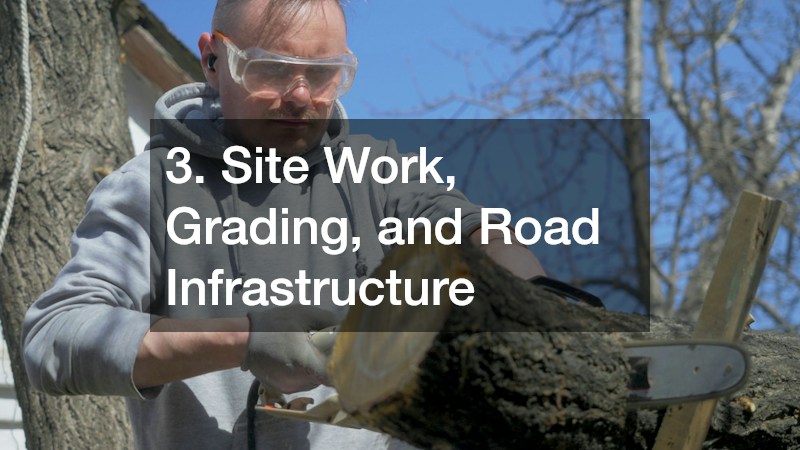
Rural land is dynamic. Without proper storm run-off management and stable road infrastructure, seasonal rain and snow can rapidly wash away topsoil, undermine foundation walls, and strand delivery trucks in deep mud.
Heavy Site Clearing, Contouring, and Water Management
Decades of neglect often leave rural building sites overgrown with invasive brush, decaying tree stumps, and failed earthen drainage ditches. Surface run-off that pools against a home’s perimeter will inevitably migrate into crawlspaces and basements.
Executing targeted excavation is the critical first step in reshaping property contours to protect primary structures:
- Clearing dense scrub and grading continuous positive slopes away from foundational footings at a minimum pitch of six inches over the first ten feet.
- Excavating dedicated interceptor swales and retention ponds to catch sheet-flow run-off from uphill ridges and steer it harmlessly toward natural discharge corridors.
- Trenching uniform, sub-frost-depth utility corridors for buried secondary electrical cables, water distribution loops, and fiber-optic communication sleeves.
Proper machinery operation ensures that underlying subsoils are not over-compacted in areas designated for future garden cultivation, orchards, or replacement septic reserve fields.
Engineering Long-Distance Access Drives
A long private driveway is a hallmark of acreage living, but maintaining hundreds of feet of roadway requires sound engineering. Inadequate base layers will cause gravel and stone to sink into native subsoils, creating severe ruts, potholes, and impassable mud tracks.
When transitioning high-traffic driveways and courtyard aprons to permanent hard surfaces, working with qualified asphalt contractors ensures the road base is properly built to handle rural demands:
- Stripping all organic topsoil down to stable subgrade and proof-rolling the path to reveal soft spots before aggregate placement.
- Laying down a heavy woven geotextile stabilization fabric to permanently separate the subsoil from the crushed aggregate stone base.
- Installing a densely compacted 6-to-8-inch crushed stone base crowned in the center to shed surface water rapidly into parallel bar ditches.
4. Job-Site Logistics, Moisture Mitigation, and Structural Envelopes
A comprehensive rural restoration is essentially a commercial-scale construction project located far from municipal supply houses. Managing job-site logistics effectively keeps trade specialists on schedule and prevents environmental cross-contamination on your property.
Job-Site Staging, Waste, and Worker Sanitation
Rural job sites demand careful logistical planning. When multiple trade crews—framers, mechanical rough-in teams, and roofers—work on an isolated property simultaneously, you must provide dedicated infrastructure to support them without stressing fragile historic systems.
Securing a reliable portable potty rental is an indispensable early move on any major rural rehab. Providing dedicated, serviced outdoor sanitation accomplishes three vital objectives:
- It keeps high volumes of contractor traffic completely out of unfinished interior living zones, preventing tracking through framing bays and subflooring.
- It eliminates physical strain on an uncommissioned, fragile, or newly restored private septic system that cannot handle high daily worker volumes.
Alongside sanitation, establish a clear material delivery depot, secure gravel turnarounds for tractor-trailers, and position roll-off construction dumpsters well clear of low-hanging tree branches and soft road shoulders.
Envelope Sealing and Historical Moisture Remediations
Old farmhouses often sit vacant for years before an ambitious buyer takes over. During periods of abandonment, uncaught roof flashing failures, missing window glazing, and unsealed fieldstone basements allow thousands of gallons of water to penetrate deep into the framing envelope.
Before installing modern high-R-value insulation or closing walls with drywall, consult a certified local water restoration company to complete structural drying and microbial control. Attempting to trap moisture behind new vapor barriers will quickly rot framing timber and create toxic living conditions. Professional mitigation steps include:
- Running industrial desiccant dehumidifiers and high-CFM axial air movers to bring framing lumber, subflooring, and joists down below sixteen percent moisture content.
- Deploying thermal imaging cameras and penetrating moisture meters to trace hidden avenues of liquid migration behind lath-and-plaster assemblies.
- Applying antimicrobial washes and encapsulants to historic timber and porous masonry to permanently neutralize fungal spores and prevent rot recurrence.
5. Heritage Outbuildings and Resilient Outdoor Living
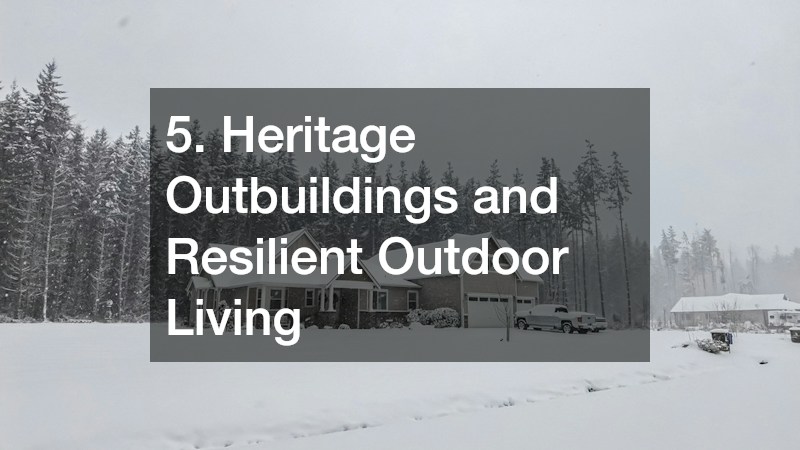
With the primary home structurally dry, mechanically sound, and properly served by utilities, you can turn your attention outward. Restoring historical outbuildings and curating functional outdoor spaces bridges the gap between historical rural architecture and modern luxury.
Preserving Historic Timber Frames, Barns, and Sheds
Antique timber-frame barns, hay sheds, and granaries represent some of the finest craftsmanship in North American architectural history. However, heavy snow loads, shifting stone footings, and wind-shear stress frequently cause heritage structures to lean or sag over time.
Instead of demolishing these historic assets, engaging experienced barn restoration services allows you to stabilize, preserve, and adaptively repurpose these spaces for modern functionality:
- Jacking and shoring massive timber bents back into plumb alignment using heavy steel hydraulic bottle jacks and temporary cribbing towers.
- Sistering rotted hand-hewn oak and pine posts, employing traditional timber-framing joinery techniques such as mortise-and-tenon scarf joints secured with white oak trunnels.
- Underpinning failing dry-stacked fieldstone foundations with modern poured-concrete footings and stem walls concealed behind original stone facades.
Engineering Weatherproof, Low-Maintenance Living Zones
Outdoor entertaining on rural acreage is centered on capturing panoramic views, fresh air, and seasonal breezes. However, building exterior structures on rural land exposes building materials to intense wind, direct UV exposure, and ground moisture without the protective tree cover or shadow lines found in tight suburban neighborhoods.
Partnering with certified Trex deck builders ensures that your outdoor living spaces withstand harsh rural microclimates without requiring constant maintenance:
- Specifying high-density, multi-layer composite deck boards that will not warp, splinter, or crack under intense summer sun or sub-zero winter freezes.
- Eliminating the continuous scraping, staining, and chemical sealing cycles required by pressure-treated softwoods, freeing up maintenance time for other parcel management tasks.
- Designing multi-level decks that step down gracefully from the main home toward outdoor kitchen areas, custom fire features, and sweeping pastoral vistas.
Practical Action Plan for Rural Restorations
Restoring an aging rural property is an ambitious undertaking, but it is one of the most rewarding journeys a property owner can pursue. When approached with an infrastructure-first mindset, thorough due diligence, and experienced trade partnerships, an old homestead transforms from an overwhelming liability into an enduring, valuable estate that delivers comfort, independence, and architectural beauty for decades to come.